How The Star Wars Traditional Matte Paintings made a huge influence in my design process.
Back in 2015 I was fortunate enough to be part of the Digimatte / Generalist team at ILM for the upcoming new Star Wars Episode VII The Force Awakens,
I was like... "The circle is now complete! " the movie that made me do what I do for living, is finally happening! it was a very surreal moment.
I knew that we had a big responsibility ahead, as a fan, I wanted to create and translate the visual language I felt in love with.
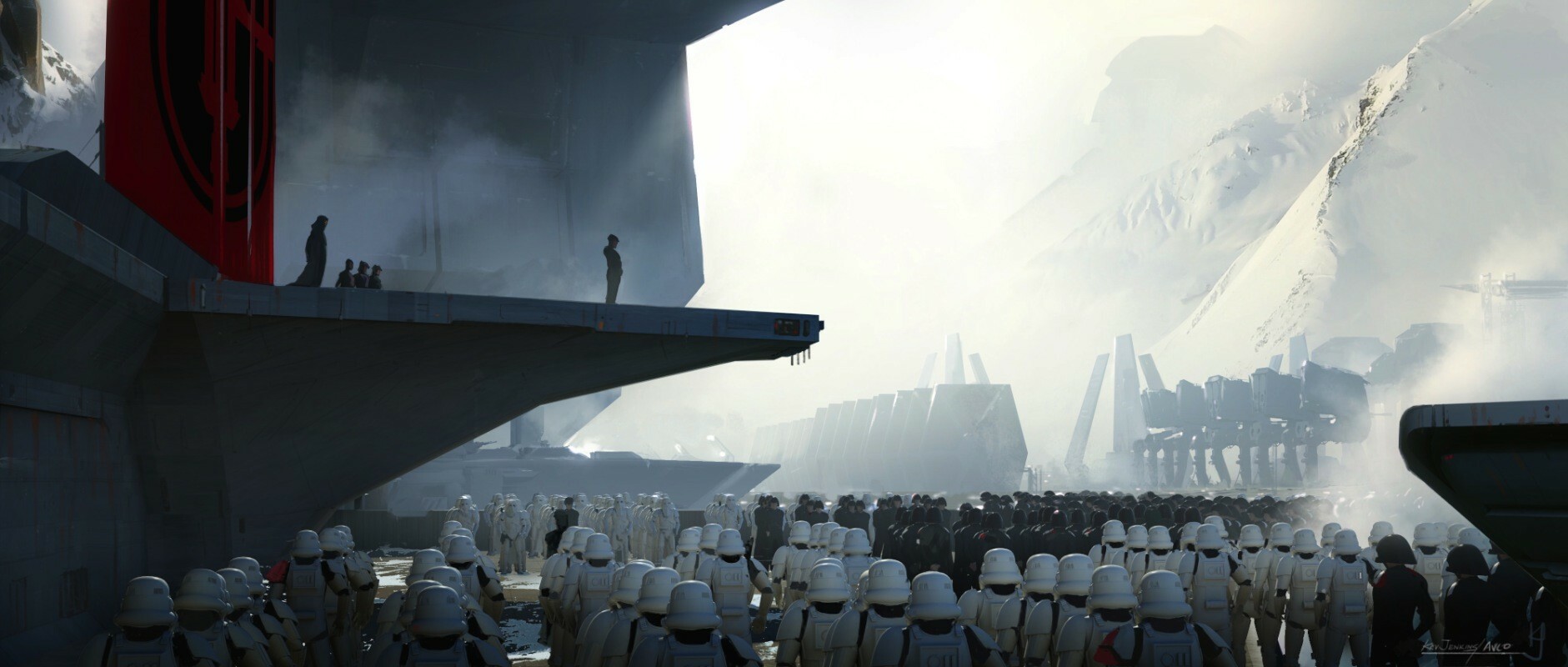
One of the main things that we worked on at the beginning was the 3D modeling, lighting and rendering of the First Order's Starkiller base where we see General Hux giving his main speech.
Susumu Yukuhiro, our supervisor, trusted Tim Mueller and myself with this task, we had only a 1 week deadline, all from scratch!
Tim and I pretty much split the environment work load, I started working and focusing only on the FG floor, main podium platform and side walls.
Actual screenshot from the Official teaser #2

All we had was a few concept art images that communicated the main idea, no element details though, taking this as a guide and also looking at the plate for shape reference, we had to fill in the blanks.
Concept Art by Kevin Jenkins
Before moving ahead, let's analyze some of the main points when talking about what Visual Language actually is.
Visual Language
The phrase visual language refers to the idea that communication occurs through visual symbols, shapes or colors as opposed to verbal symbols
Elements:
- Composition
- Design is the process of selecting and organizing elements or components in order to fulfill a specific purpose, this purpose may be functional or aesthetic, or (frequently) both.
- Definitions and Qualities of lines
- Value
- Shapes: Positive, Negative and planar issues
- Mass
- Space
- Color: it's qualities and combinations
- Texture and Pattern
The Sum Is Greater Than Its Parts, Individual elements placed near each other are perceived to relate to each other, and create a different effect than the elements would individually. Things near each other are perceived as a group. An object separated from a group of similar objects by a large amount of negative space conveys isolation.

We don't need to know what movies these environments are from, or even who do they belong to, it's a given, the visual language is so strong and prominent that we know those capsule light pattern and grey colors are Imperial, and those round wooden door frames are from the Hobbit Village.
The instant connection to not only the movie but where they belong to is what visual language is, the shapes, colors and patterns talk to you, a very important element in the narrative.
So, here I am, starting my part of the environment from scratch, blocking it out , making the basic shapes and filling in the blanks, I needed some inspiration so I took a look back to Return of The Jedi specifically, 2 main elements helped me design and give this Podium platform some character, the shot was going to be almost front lit, strong Sun light and hard shadows I knew I needed to add sharp and clear detail.
Plate

I was looking for some elements that connect this new movie with the original trilogy, I had to design the podium and walls, so I took a look at these matte paintings from Return of the Jedi by Frank Ordaz, one of my favorite traditional matte painters and amazing fine arts artist.
I was looking for specific I could used to design this Podium, not only from the design and visual language point of view but also the architectural structure that will help me give a logical sense of how it was built.
I looked for parts and pieces that give general structure or support to the building, like in this Endor's platform where I pretty much grabbed the same elements and adjusted them to my structural base.
Also that thin horizontal pattern helped me make it look "Imperial"

I needed some structural support pillars on the sides and I grabbed the idea from this other Matte Painting by Frank Ordaz as well.


With this same logic is how I've been working on several other projects or pre- existing IP's, as artists, we have the responsibility to keep the magic and pass it on new generations, I want to share the joy I had when I was a kid and how amazed I was by all those visuals.
To stand out, you will have to master your design skill, is not about how well you use the tools ( software ) but how well you solve the creative problem, it's a thought process.
These skills it takes time and dedication, be patient and work hard.
More Environment work
In the Film I had the chance to work on different environments, from Jakku's full CG environments and Matte paintings to the snowy landscapes we see at Starkiller base, all of them with the Millennium Falcon in action!
Another surreal moment was when I was importing the Falcon to my 3ds Max scenes, I think I was frozen just looking staring at the monitor, trying to process what's happening and happy that it finally was happening 🙏😂


I was in charge of creating this full CG Environment, on this 180 ° camera move, all done in Clarisse, with BG Matte Paintings projections as well.
This one was a challenging 3D environment as the snow was flattening all the shapes, it certainly took some time to find the right values and to build everything from far BG to the FG detailed rocks on that cliff where the Falcon crashes.


Jaime Jasso